Dance Dance Revolution: SuperNOVA 2
The early 2000’s were an interesting time for arcade games. The market for arcade games had been in decline since the 1980’s, with machines being expensive and starting to lose their competitive edge against home consoles, many arcades either shifted to focus more on games of skill (Dave and Busters, Chuck E Cheese) or they would just shutter entirely. At the same time some of the hottest arcade game releases came out in this period of time. Time Crisis 3, House of the Dead 3 and 4, Taiko: Drum Master (Taiko no Tatsujin for you nerds out there) all came out during this time period, but none made quite a splash like the Dance Dance Revolution series.
Even before the turn of the millennium DDR (Dance Dance Revolution) had been turning heads. Imported to things like anime and gaming conventions the rhythm game that turns your body into the controller was getting media attention and a global fanbase; so of course the next logical step is to move from the arcades to a home audience with a series of console releases. While many releases came out across the console generations, the one that holds a special place in my heart is SuperNOVA 2 for the Playstation 2.
Setting the Dancing Stage
I chose to look at SuperNOVA 2 for a few reasons. Firstly, it’s the one I grew up with so I have a special place in my cold shriveled heart for it. Secondly, it’s one of the last console releases to coincide with an actual arcade release (the final would be DDR X but I haven’t played that one ((yet))). Thirdly and finally, I feel like the library for this game encapsulates exactly why this game was so popular for so long, but why it died off shortly after the 2010s.
Developed by Konami’s Bemani group, the group that does their music games and not just DDR related stuff, SuperNOVA 2 is a rhythm game following the traditional DDR formula plus some tweaks that separate the experience from the previous Extreme line of console games. Arrows pointing up, right, left, and down come from the bottom of the screen in roughly the same rhythm as the music; and you score points by hitting the correct direction with the correct timing.
To this end you have beat maps (the pattern and speed the arrows would come in) for over 70 different songs running the gamut from pop to Eurobeat. A heaven-sent boon for someone like me in the early 00’s; back when your choices for getting songs were your local music store, book store, or using a sketchy download site to get ‘Inuyasha CHANGE THE WORLD hidef ~full~.mp3’ as well as a catastrophic amount of viruses.
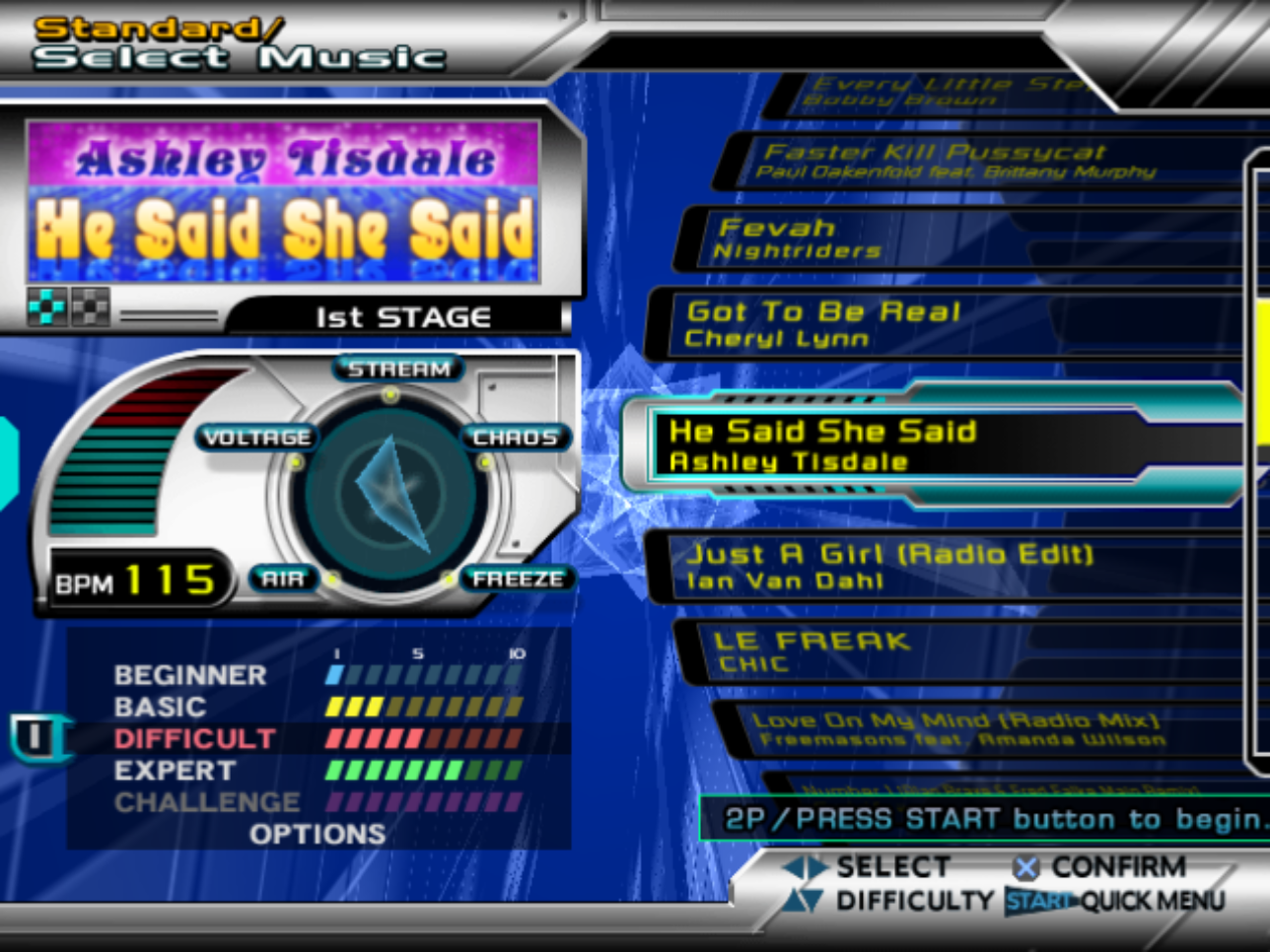
Anime openings, 2000’s pop, and original Konami songs give a little bit of flavor for everyone.
You move smoothly
As mentioned before, the aim of the game is to match the inputs on screen to the inputs on your controller. If you bought the game brand new, this means using the foldable plastic dance mat bundled with the game to stomp out the arrows to truly replicate the arcade experience one-to-one. If your time machine is broken, you’re broke, or otherwise can’t use a dance pad because of apartment living; all game modes that I’m about to mention are also perfectly playable with a standard PS2 controller.
The arrows are programmed to match the beats and rhythm of the song associated with it, and the closer you get to perfectly matching the inputs the better score and eventual ranking you’d get at the end. With ‘Marvelous’ meaning you hit the input perfectly and ‘boo!’ a complete miss, you get a pretty clear picture of how well you’re doing throughout the game. Do well enough, and your dance meter fills while the game’s commentator praises you; do poorly though and deplete your dance meter the game will end prematurely while the commentator instead starts asking if you’re okay.
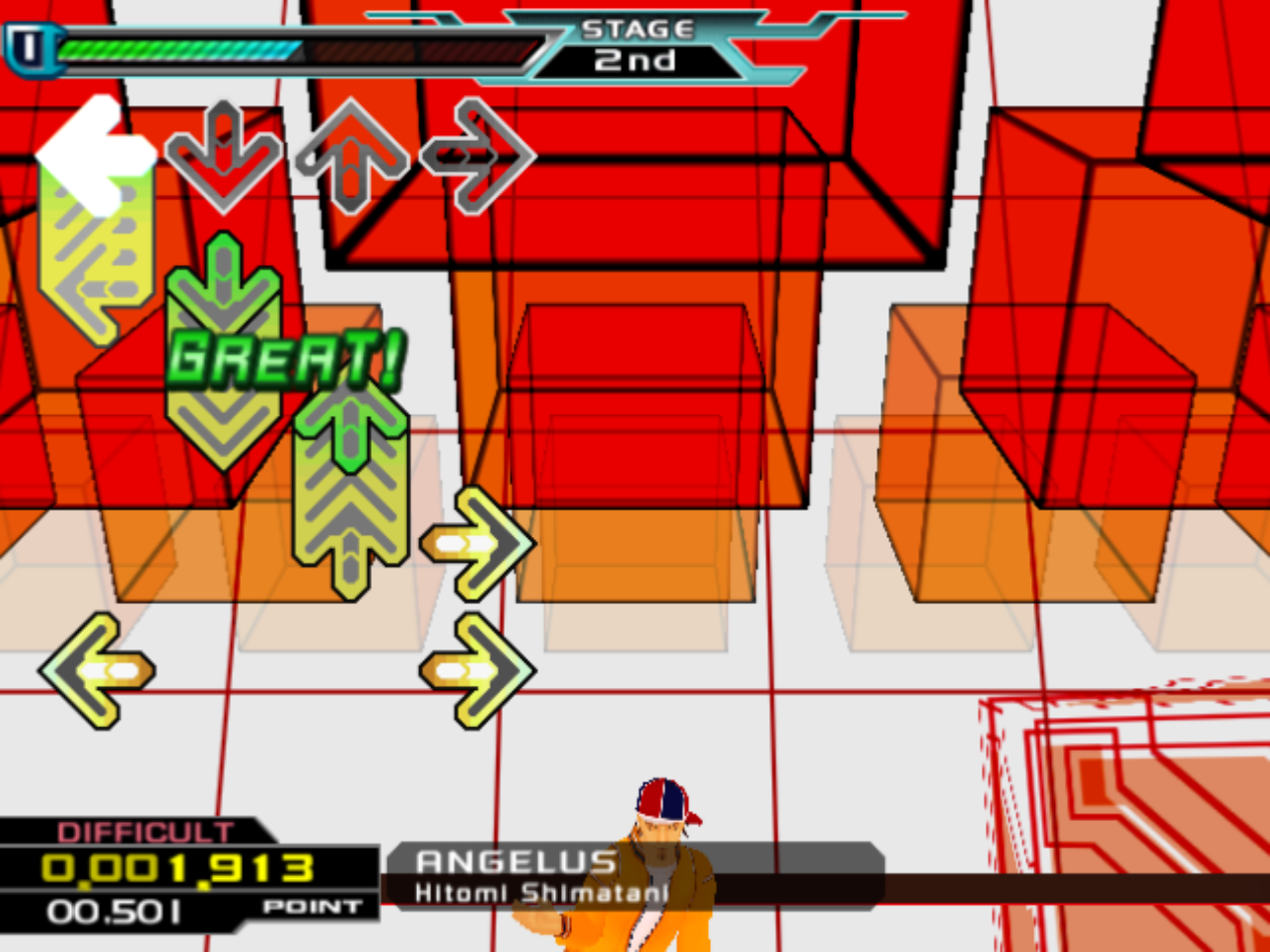
Held notes add additional challenge. Release too early and you’ll earn a ‘no good’ rating for that note.
Each song has a highest possible score of 1,000,000 points, and the more marvelous ratings you get the closer you get to that score and a coveted AA rating. Flunk out of the song though, and you’ll be given an F for your troubles and encouragement to try again.
On a dance pad or with a gamepad plugged in, the controls are responsive. In the hours I dumped into playing this game, there was never a time I missed an input and felt the game was to blame for it. I may have struggled with the pace on some songs, and some beat maps do contain tricky jumps but any time I got a poor score I could look back on it and say honestly “Yeah I probably deserved that, let’s try it again.”
Rock Your Body
While the core arcade gameplay is available on SuperNOVA 2 the main draw of buying a console copy, aside from not having to drive out to an arcade (if one even exists near you) and having to wait thirty minutes for some sweaty otaku to finish with the machine, are the variety of modes packaged with the home release. You can pick a song and do the standard single player, versus, or double dance mat fare you could get at the arcade through the creatively named “Game Mode” game mode, but the home releases offer so much more; with SuperNOVA 2 offering one of the best single player experiences of any home console release.
Returning from previous console releases you have course mode, combo mode, and endless modes; popular with the more challenge focused gamers. Returning from SuperNOVA specifically is battle mode, a versus format similar to a dancing version of puyo pop. Workout mode also makes its return, encouraging players to get fit by setting goals and recommending courses to help reach those goals through the power of dance.
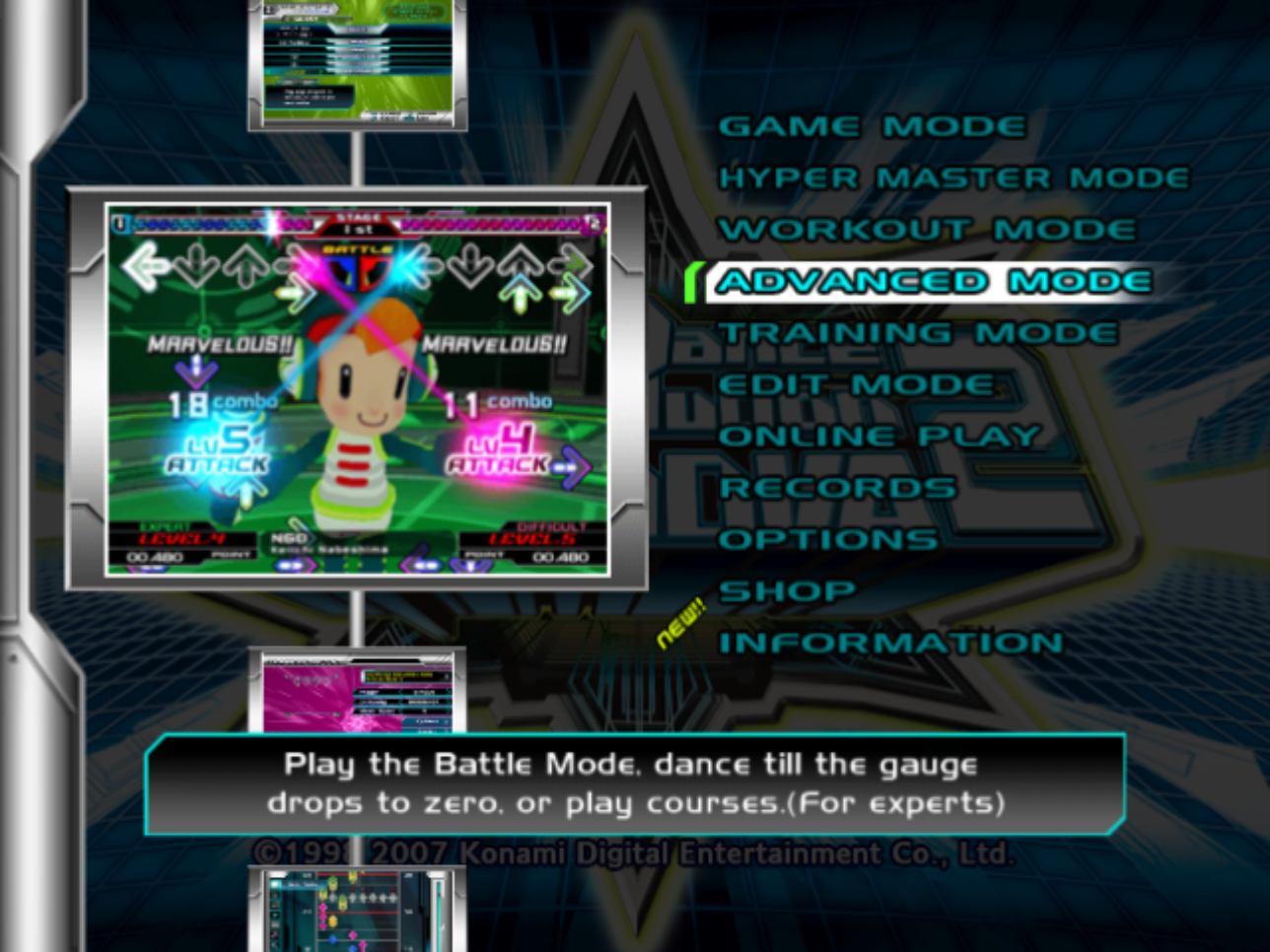
Battle Mode can be a fun party distraction, or a fresh experience if you get tired of standard gameplay.
The main draw, however, that sets SuperNOVA 2 apart from SuperNOVA and the Extreme series is Hyper Master mode. This games’ single player campaign, similar to previous entries campaigns, sees you completing a linear list of songs while meeting goals like ‘pass with your dance meter at least 80% filled’ or ‘finish with a B rating’. Songs start out easy and simple, with no modifiers but gradually the game begins to introduce challenges to spice up the experience.
Varying the speed the arrows flow at, hiding the frames to make scoring harder, or placing the frames at the bottom of the screen instead of the top are just some of the ways SuperNOVA 2 messes with the player.
Hyper Mastery
The greatest difference between SuperNOVA 2’s campaign and previous games, aside from the fact that it’s relatively linear compared to things like the stellar club system in SuperNOVA, is the modules system. While in Game Mode and other modes you have a decent cast of dancing avatars to spice up the background, only one avatar is usable during Hyper Master mode. A blue robot named Concent Be-fU (D2R-2007), yes that’s really the full name, acts as the main dancer mainly to facilitate the new customization features that enhance the gameplay.
Modules come in three flavors: Support, Challenge, and regular varieties. Any module you buy can be equipped to Concent during the Hyper Master Mode and aside from altering his appearance slightly your gameplay and final rating will also be affected.
Supportive modules can offer huge benefits to the player. Reducing the number of notes that can appear, cutting certain patterns from the game, increasing the speed at which you gain dance meter, or even preventing you from losing dance meter temporarily when you miss a note can help clear the harder missions in the game; at the cost of your overall ranking and score meter being impacted at the end. You might not be able to unlock the secret stages if you use support modules, but if you hit a wall, you can always unequip the modules and come back later to deal with harder songs.
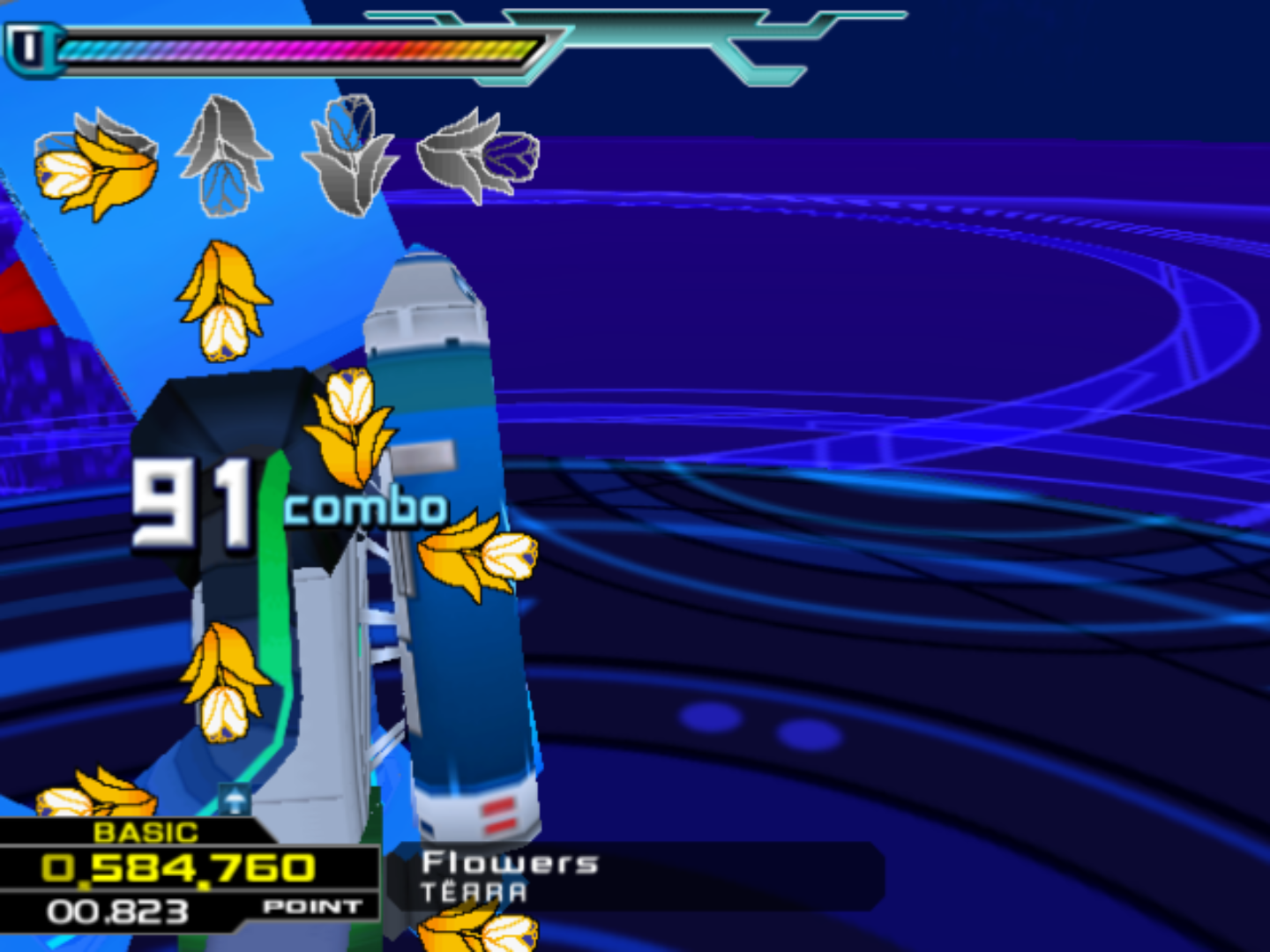
Some modules don’t increase or decrease difficulty, but change minor things like the shape of the arrows/frames.
Challenge modules, conversely, up the difficulty. The same challenges you might face for one or two songs in Hyper Master mode can be applied to every song, as well as penalties like slower dance meter gains and harsher consequences for missed notes. The trade-off is, in addition to your normal score, you’re provided a Hyper Master score as well. Unlike how Support modules penalize you, however, challenge modules provide no bonus. The hyper master score doesn’t provide anything, just a bragging rights reward and a sense of accomplishment.
It creates a nice balance. There’s no way to adjust the difficulty of the songs themselves but with this module system players can experience the game the way they want to without the game necessarily becoming prohibitively hard or boringly easy. If you want disappearing notes that come at double speed, you can have that and post the results these days to reddit. If you don’t want to jump around, you can turn off jump notes entirely then come back to it when you feel more comfortable.
Don’t want to alter the gameplay at all? You can spend the points earned on other goodies as well such as song unlocks for Game Mode, skins for the arrow frames, and even new game modes. The only real downside is that all of these unlocks, as standard from previous games, are locked until you reach certain points in Hyper Master mode. If you want the fish themed arrows, you gotta wait until you beat Calico Cat Rock first.
Take a bow
In the end though, the amount of enjoyment you’ll derive from SuperNOVA 2 is based largely on a number of subjective factors. This is, of course, true for every video game but for this one and others like it you’re looking at more starting hurdles than “do you like platformers or shooty games?”. If you’re bad at rhythm games, don’t like dance/EDM music, dislike loud bright colors, or any combination of those factors apply to you then you’re gonna have a bad time.
On top of that while you CAN play the game with a gamepad on standard hardware and emulated hardware, you’re definitely not getting the full experience. Features like double mat mode might work fine, but other modes like the workout mode lose some of their appeal as the games estimations on calories burned and other numbers are based on the idea that you are in fact up and moving. You can also buy these peripherals still for relatively cheap prices but unless you’re playing other dancepad games it’s not worth the investment.
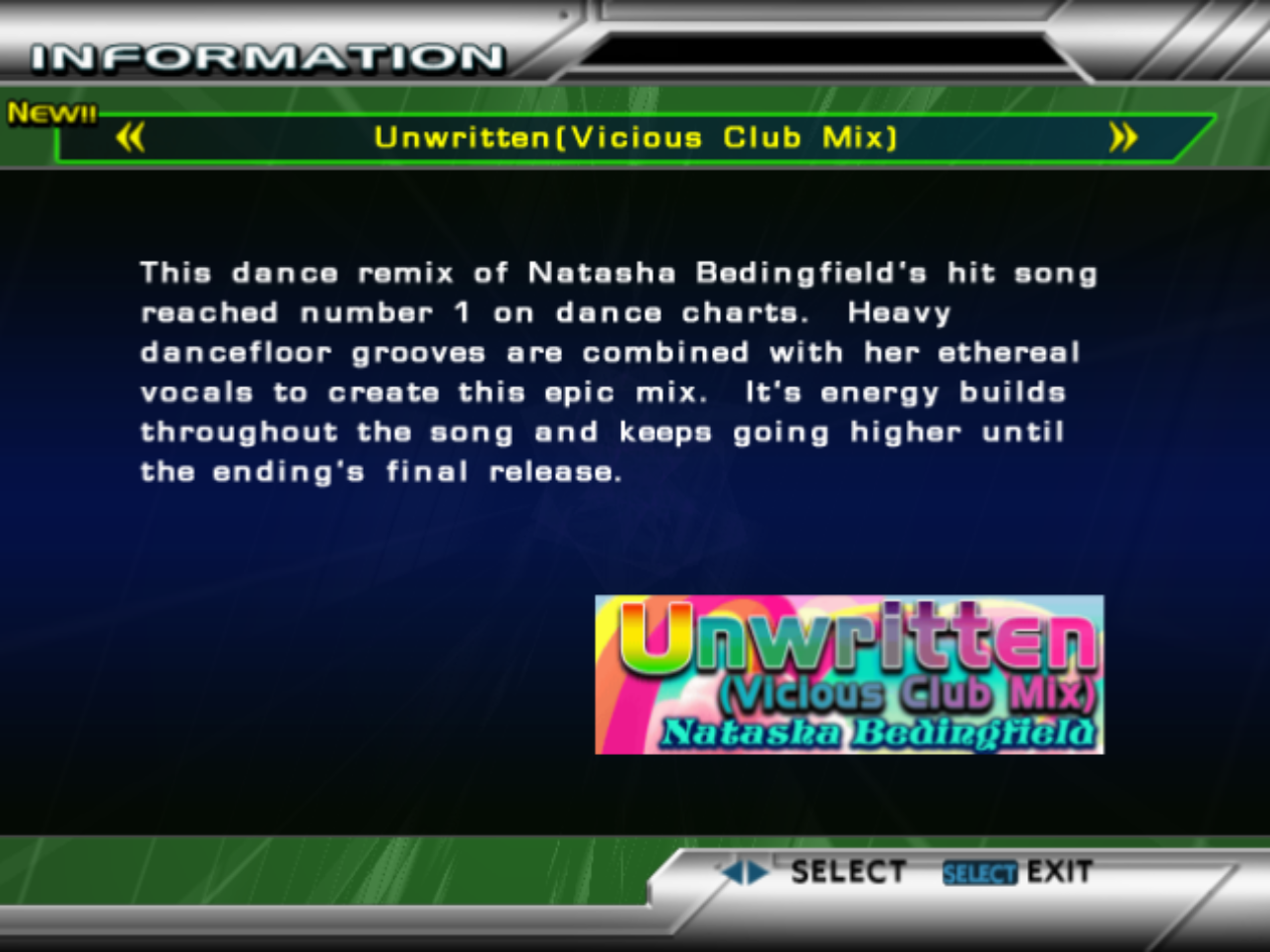
If you enjoy learning about the songs in rhythm games, small info blocks can be unlocked by simply completing the song in any mode.
Otherwise though, this game is a great entry to check out for rhythm gamers. The game is bathed in that Y2K futurism aesthetic that was popular at the time, giving it a style that matches the games’ heavy focus on dance music. The audio of the game, highly important for such a game, is crisp and clear with a library given enough variety to appeal to even more normie gamers (assuming they grew up in this time period and/or are an ironic/unironic y2k music enjoyer or singers like Brittney Spears and Chris Brown).
These days you have no shortage of options, with similar games like Pump-It-Up and Beatmania being more common sights at arcades than Dance Dance Revolution even. But if you want to see the progenitor and understand why it was such a craze that even schools were viable marketing targets then this game is a good entry point, barring any editions that might have specific songs you’re looking for.
Overall Score: 7/10
Memorable Moment: Finally, after all these years, beating “Fascination ~Eternal Love Mix~” in Hyper Master Mode